
How I teach...listening
a journey from avoiding it to presenting at conferences about it.

Welcome
For a long time, listening was the part of language teaching I avoided most. Not because I didn’t value it, but because I didn’t know how to teach it and neither, I suspect, did many of the people around me. This blog, Field Notes of a French Teacher, is a place for me to document how my thinking and practice have evolved as a practising French teacher in an independent school in Australia, particularly in areas where my confidence was once lowest. What follows is the story of how I went from quietly avoiding listening in my classroom to writing, speaking, and presenting about it. And why I now believe listening deserves far more deliberate attention than it usually gets.
Listening: the Cinderella skill
Listening has been called the Cinderella skill by a number of researchers (Nunan, 2002; Vandergrift, 1997). This comes from its tendency to be overlooked, underappreciated and neglected. I have recently presented on this topic at two separate conferences. But it wasn’t always this way.

I neglected it. Big time.
In fact, I used to avoid it. That feels both uncomfortable but also therapeutic to admit now, given how much I now write and talk about listening. But for a long time, “doing” listening was the part I dreaded most. Essentially, whenever I did listening, my students struggled. And I was powerless to help them. So I just didn’t do it. My logic was that if I didn’t do it then they would not struggle and I would not look like a wally in front of the teacher observing me for not knowing how to help them.
Once upon a time
I remember one observation particularly clearly. I’d put on a listening task. My students struggled. Faces dropped. Panic rose. And, eventually, I asked them:
“Shall I just read it out?”
They all said yes. Instantly. Unanimously.
The feedback I received afterwards was, frankly, fairly damning. My observers said I should not have done that. It’s easier to listen to me than to listen to an audio and therefore I had undermined the task and removed the challenge. I agreed.
But with the benefit of hindsight, I can see something else going on.
The task was simply too hard. And it was a centrally planned lesson so I had very little control over this.
I was also told I could have paused it more or replayed sections. And maybe that would have helped in the moment. It might even have made the observation go smoother.
But it wouldn’t have solved the underlying problem.
All I would have been doing is learning how to compensate for students’ underdeveloped listening skills and teaching them how to survive listening tasks, rather than improve at listening itself.
We don’t know what we don’t know
One of the things I’ve come to understand is that this was more than just a personal failing. The observers’ feedback, whilst valid, served only to accommodate (rather than address) students’ underdeveloped listening skills. My theory is that they didn’t have the expertise to help me. And that’s not a dig at them. The expertise in listening instruction was not out there. And to be truly honest, I’m not sure if it is in 2025. Teachers in my placement schools were always talking about “doing” a listening. Siegel (2014) talks about listening activities used without much consideration for their place within a learning sequence. There was never any discussion of listening as a skill to be developed. In fact, there was some research to suggest it was a passive skill which did not need to be (Rivers, 1996) (not that I was aware of this at the time).
The lack of expertise in this area is something highlighted by the brilliant Suzanne Graham (2017) who found that teachers were not familiar with research regarding the listening process. She also found that teachers’ practice in the area of listening amounted to the Comprehension Approach (Field, 2008) whereby learners listen to audio and complete tasks which test comprehension.
Trial and error. Mostly error.
In my next school, I did slightly more listening. The source of audio was usually me, due to my encountering another (common) issue: availability of quality audio. This is one of the biggest issues in the area of listening instruction and a major obstacle in the development of listening skills.
I then moved onto another school in the Middle East where I taught KS3 French and most notably iGCSE French. The audio for the iGCSE classes came from one textbook mainly. The listening activities were always comprehension-based. And the following scenario, taken from Kedi Simpson’s superb blog, repeated itself over and over:
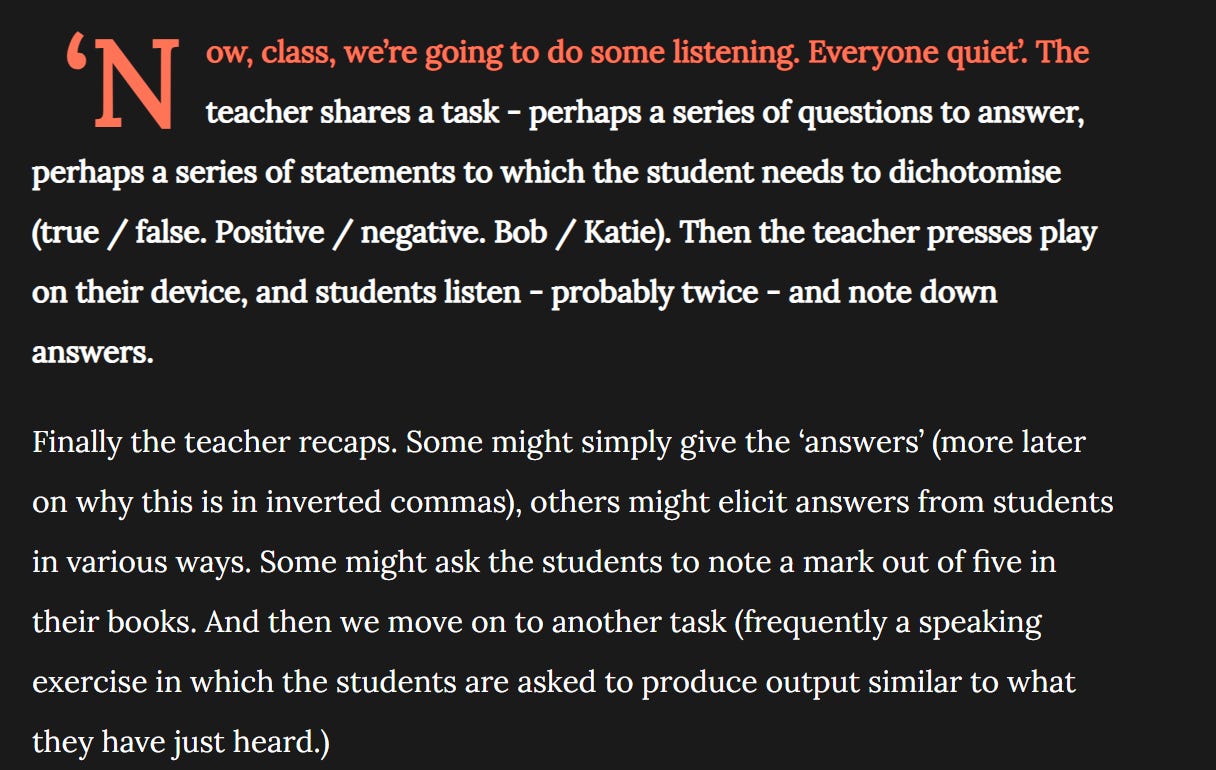
I was mainly a “show me your mark out of five” kinda-guy. The issue with this approach wasn’t the way I recapped. It was that students weren’t getting better at listening through doing this. I didn’t know it at the time, but I was subjecting my students to what Daniel Pink (2009) calls excessive challenge: repeated failure at the same thing, with no sense of progress. According to Pink, this causes a sense of overwhelm, stress and helplessness and negatively impacts intrinsic motivation.
Something else happened during this time which frustrated not only my students but also me. I discovered - to my horror - the awful way in which the listening exams seek to trick the students and entice them to fall into traps in order to select the wrong answer. Often, the exams did this to the extreme, with sentences that were unnatural and inauthentic and therefore impossible to predict. I found it really unfair and unreasonable. However, I resolved that my duty was to set my students up for success and therefore we spent a lot of time on exam practice, especially in thinking about synonyms and equivalent expressions. On reflection, this could be considered useful for my students’ top-down skills as they developed strong pre-listening routines. But their tendency to still fall for the traps or be misled or not be able to perceive the individual words pointed to another issue: underdeveloped bottom-up skills.
Started from the bottom, now we’re here.

I came to the realisation that there must be another way. Teaching iGCSE forced me to confront how fragile my students’ listening really was. They weren’t necessarily failing because they lacked vocabulary or grammatical knowledge; they were failing because they couldn’t perceive the sounds and words. This realisation led me to Gianfranco Conti’s EPI methodology and specifically LAM (Listening as Modelling). I read Breaking the Sound Barrier for the first time and discovered the work of John Field. What resonated most was that - finally - listening was being presented as a set of skills that could and should be taught. This was enlightening. Finally, listening had been demystified.
I began tentatively, trialling LAM-style activities to develop students’ listening skills, first with my iGCSE classes and then with some of my younger groups. I bought the Language Gym books myself and started using the listening activities, curious to see whether focusing on decoding and processing would make any difference. Almost immediately, it did. Students experienced more success with listening; they seemed to enjoy it more, or at least dread it less. Listening stopped feeling like a trap and began to feel like something they could get better at. Fast forward a few years and I moved to my current school, where listening was still largely approached through comprehension tasks. Students were “doing” listening, but their listening skills were not being developed. Following a curriculum review of Years 7–9 by two members of the Senior Leadership Team — involving lesson observations and close scrutiny of curriculum materials — one of the key recommendations was a greater focus on skill development. In particular, they noted lessons where students struggled significantly with listening. In response, I proposed a curriculum overhaul, adopting Gianfranco Conti’s EPI methodology in Year 7, with a view to extending it into Years 8 and 9. This involved my completing the EPI Teacher course and then Gianfranco coming to our school to deliver EPI training to 50 local teachers including all of ours. We have just completed our first year of the new curriculum in Year 7 and have begun teaching it in Year 8. Year 9 will follow in 2027. The early results have been genuinely encouraging: students are noticeably more confident with listening than previous cohorts, suggesting that when listening is taught deliberately, it becomes far less daunting. Quelle surprise.
Below is an approximate roadmap of how listening is now taught in our school:
1. Explicit phonics and sound–spelling relationships
Listening instruction begins with phonological clarity. Students are explicitly taught:
Core phonemes of the language
Common sound–spelling correspondences
High-frequency grapheme–phoneme patterns
Key sources of phonological confusion (e.g. liaison, elision, weak forms)
This stage is about helping students hear the language accurately. The goal is not comprehension, but accurate perception: being able to distinguish sounds, syllables, and word boundaries. This directly supports speech stream segmentation and reduces cognitive load later.
2. Controlled decoding of short, meaningful input
Students then work with very short, carefully controlled listening input, often at word, phrase, or simple sentence level. Activities focus on:
Identifying words or phrases they already know
Matching sounds to written forms
Noticing how familiar language sounds in connected speech
Repeated exposure to the same structures in slightly varied contexts
At this stage, listening success is deliberately engineered. Students are not asked to “understand everything”, but to practise decoding and recognising language they have already encountered in reading and input.
3. Extensive repetition with minimal variation
Since EPI emphasises massive, structured exposure, listening texts recycle:
The same core vocabulary
The same grammatical structures
The same phonological patterns
Across multiple lessons, students hear the same language many times, with slight changes in context or meaning. This repetition supports:
Automaticity
Faster word recognition
Reduced reliance on translation
Listening becomes less effortful because the language is increasingly familiar at a perceptual level.
4. Listening for meaning without comprehension pressure
Once decoding becomes more reliable, tasks gradually shift towards global meaning, but without the high-stakes demands of traditional comprehension questions. Activities may include:
True/false or forced-choice tasks
Matching ideas to images or summaries
Sequencing events
Identifying gist rather than details
Crucially, students are not punished for partial understanding. The emphasis remains on successful processing rather than performance.
5. Developing top-down strategies alongside bottom-up processing
As students’ decoding improves, EPI integrates predictive and inferential listening:
Anticipating what comes next based on context
Using prior knowledge to support understanding
Tolerating ambiguity and uncertainty
This aligns with John Field’s view of listening as an interactive process, where bottom-up decoding and top-down meaning-making develop together — but only once the decoding foundation is secure.
6. Gradual increase in text length and complexity
Only later do listening texts become:
Longer
Faster
More naturalistic
Less tightly controlled
By this point, students have:
Stronger phonological awareness
Greater lexical familiarity
More confidence in their ability to cope with spoken language
Listening no longer feels as cognitively demanding, because students have been prepared for it.
I recently completed a Masters in Education (Teaching and Learning) with the University of Buckingham, where my dissertation focused on listening and the impact of explicitly teaching both bottom-up and top-down skills on listening comprehension. I’ve spent a long time reading the research and thinking hard about listening instruction, but I’m very conscious that this is still a work in progress. What has changed is that listening now sits at the centre of my classroom practice rather than at the margins. Through this blog, I want to continue documenting that journey: what it looks like to teach each of the four skills deliberately, what I’m still grappling with, and how theory, training, and day-to-day classroom reality intersect.
Thanks for reading.
You document a very similar journey to my own with EPI, with similar outcomes for the students. How it supports those SEN students who have challenges with retention or reading has been transformational, as the support is there as a baseline for their success; and the repetition promotes familiarity far more than vocabulary lists ever did.
Thankyou for putting this out there.